ctxd
Context infrastructure between agents and data
Developer ToolsOpen sourceOpen source · verified
Launching today, Nov 3, 2026 · currently #7
What is ctxd?
ctxd is open-source context infrastructure between agents and data.
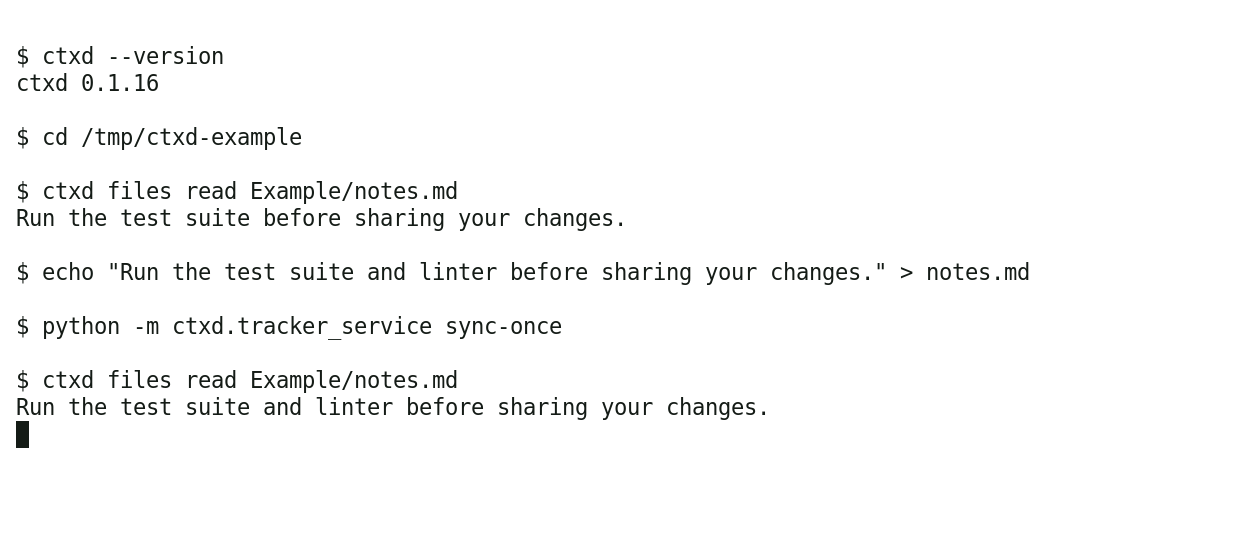
Its local tracker syncs source content into ctxfs, a context filesystem. Agents can inspect paths and read files or selected line ranges. Python and the CLI also provide exact text search. Edits and removals reach the store after synchronization.
Use it through Python, the command-line interface (CLI) or Model Context Protocol (MCP). The local MCP bridge uses standard input/output (stdio).
Install: pip install ctxd
ctxd features
- Sync source edits and removals into ctxfs.
- Inspect paths and read files or selected line ranges.
- Access context through Python, CLI or MCP.
Who uses ctxd and for what
- Let an agent read current project documentation after edits and synchronization.
- Use the same source context from Python code, shell commands and an MCP client.
ctxd FAQ
What is ctxd?
ctxd is open-source context infrastructure between agents and data. Its local tracker synchronizes source content into ctxfs, a context filesystem.
How do I use it?
Install with pip install ctxd, configure the context store, add a source and sync. Access source content through Python, the command-line interface (CLI) or Model Context Protocol (MCP).
Is ctxd free?
The open-source ctxd package is free to install and run on your own infrastructure.
Comments (1)
More Developer Tools launches

Feel iOS haptic patterns on a real iPhone, copy the code
Deploy anywhere from your AI tool.

Free product launch platform for indie makers
Akii: SEO & AI Search OptimizerOpen source · verified
Free SEO, AEO and GEO tools for Claude Code.
Compare hosting, VPS, and domain prices side by side
Monitor Laravel scheduled tasks and queues

OriginForge Studio Nov 3, 2026
Exposing synced source content as a filesystem that agents can browse and read by line range is a neat way to avoid stuffing whole documents into a prompt. I like that edits and removals only reach the store after synchronisation, as it keeps the state predictable. How do you handle a large repository where a sync takes a while, and can an agent tell it is reading slightly stale content?